 worldclassmanufacturing.ai
World Class
Manufacturing
in the Age of AI
Skip the Fourth Industrial Revolution
Contents
Part I — The answerThis document
Why the last attempt did not pay, what has changed since, and the principles that follow.
The organizational design the principles imply, the roles it changes, and why the core has to change rather than the edge.
The products, the stack underneath them, and the physical automation they reach.
Part IV — Industry-specific recommendations
Where the general argument meets a particular sector, and what changes.
- Automotive
- Aerospace, Defence and Space
- Custom Fabrication
- Industrial Equipment and Automation
The objections, the constraints, and the conditions under which this argument fails.
- Return on AI Investment
- Security, Validation, and Liability
- Fear of Job Loss
Who this is for
- Manufacturing C-suite setting direction on AI and digital
- General managers and plant managers accountable for a site's results
- Operations managers and directors who own a value stream end to end
- Lean, CI and World Class Manufacturing practitioners deciding where AI belongs inside the pillars
- Engineering, quality and maintenance leaders whose functions change shape first
- Anyone who approved an Industry 4.0 programme and is still waiting for the return
The opportunity
This is a blueprint. It sets out what changes in a manufacturing organization under AI, in what order to build, who has to own what, and what it costs.
The opportunity is not a new one. Industry 4.0 promised most of it a decade ago, and the investment behind it was real: historians, SCADA, MES, sensors, dashboards. That description flatters where most plants actually stand: Industry 4.0 status was never reached, and the operation still sits squarely in Industry 3.0 territory, where the automation is real and almost nothing is connected between it. Where the layer was built, though, it is the strongest foundation a plant has to work from, and the premise behind building it was right. What went wrong was the order of operations. It started with data and went looking for the workflow afterward. Detection got automated, the work itself stayed exactly where it was, and the return stayed theoretical.
The promise is still available, and collecting on it does not mean starting over. It means changing the order of the build. Organization first, because someone has to own an outcome before anything built for it can survive. Then the workflow that proves value on one flow. Then the data products that workflow specifies, because now there is a consumer to specify them. Then the surfaces people decide on, and last the shared platform those products have earned.
Every one of those steps is conventionally done in reverse, and the reversal is what makes ownership sit in a central function that can build a platform but cannot run a flow. The sequence reveals it has to start at the core of manufacturing operations.
Using the blueprint
Read it through once for the argument. The sections build on each other and the ordering matters more than any single recommendation in them.
Then work the In practice block at the end of each section. That is where the argument becomes something to act on: what it requires of an operation, what it depends on, what it costs, and where it does not apply at all.
One thing is worth deciding before you finish reading. Pick the flow in your own operation you would rebuild first: the one whose problems consume the most senior attention. Every section is sharper with a specific candidate in mind, and the first build is where this stops being a blueprint and starts being a result.

Part I
The answer
Why the last attempt did not pay, what has changed since, and the principles that follow.
Section 1Permalink
Why Industry 4.0 Did Not Deliver
For three decades, World Class Manufacturing described a plant where machines executed and people thought. The operator watched a well-timed routine and stepped in when something needed judgment. The assembler performed a simplified, repeatable task designed to be learned quickly. Maintenance, quality, and cost control were staff functions that diagnosed problems on behalf of the line.
Generative AI changes what thinking means as a job description, and it changes who is expected to do it.
Richard Schonberger drew the problem underneath all of this in 1986, and the drawing has not aged. He sketched three pictures on a single page. Operations are planned as a straight horizontal line, one step feeding the next. The people responsible are organized as a set of vertical arrows, each pointing down through its own function. And the jobs themselves move among machines and assembly stations as a tangle of crossing arrows going in every direction at once. His conclusion was blunt: it is ineffective to have process engineers design the work process, general managers design the organization of people, and industrial engineers design the flow. Three designers, three incompatible geometries, one plant expected to run on all of them simultaneously.
It is insane for the operations to be planned this way…
…the people to be organized this way…
…and the jobs to move among machines and assembly stations this way.
Three panels, drawn at the same scale. On the left, the operations plan: one arrow running left to right, each step feeding the next. In the middle, the organization of people: three separate arrows running top to bottom, each pointing down through its own function and never touching the others. On the right, the movement of the work itself: six arrows crossing each other in every direction at once. The three drawings share no geometry. Process engineers designed the first, general managers the second, industrial engineers the third, and one plant is expected to run on all three simultaneously.
That is the whole argument for why the World Class Manufacturing playbook needs revisiting rather than replacing. Schonberger's three geometries were never reconciled, and not because nobody noticed the problem, since he published the diagram and the industry read it. They were never reconciled because doing so required a single person to hold the process, the organization and the flow at once, and no such person could be reliably produced. Hold that constraint in mind.
What Industry 4.0 got wrong
Before naming the role that becomes possible, it is worth being precise about the one that was tried last and did not work, because the failure was structural rather than technical and the same structure is on offer again. A decade of Industry 4.0 investment bought most plants a great deal of real capability and did not deliver the transformation it promised. The reason is not that the premise was wrong. Industry 4.0 is a data-centric approach at its core, and data is genuinely the strongest of the three legs any AI capability stands on. The flaw was the ordering: it started with data as the first move.
Some history makes the point better than any argument about AI does. Each industrial revolution is named after a technology, but none of them paid out for the technology. They paid out for the organizing pattern the technology made possible, and in every case the pattern arrived years after the machine did. Carlota Perez's term for this is a techno-economic paradigm: not the invention itself, but the model of how to organize work around it that eventually becomes common sense.
| Revolution | Named for | The principle that set layout and organization |
|---|---|---|
| First | Water and steam power | Proximity to the power source. One engine or wheel, a vertical main shaft, line shafts along every ceiling. Machines went where the belts could reach, which is why mills were tall, narrow and compact. Labour was gathered under one roof and one overseer for the first time. |
| Second | Electricity | The sequence of the work. A motor on each machine cut the plant loose from the shafts, so machines could finally stand in the order of operations. Single-storey, wide-span, rearrangeable. Organizationally: the product moves, specialized labour stays, and a managerial hierarchy coordinates between functions. |
| Third | Electronics and the PLC | The programmable machine. Cheap changeover made mixed, small-batch production viable, so machines could be grouped by what they make rather than by what they are, and the operator moved from performing the cycle to supervising it. It also gave every machine a controller, and therefore something to report, which is the precondition for everything after it. |
| Fourth | Connectivity and sensing | Proximity to the platform. The machines got connected, and everything the data touched was arranged around hauling what they said to one place: a historian, a lake, a central team every use case had to queue through. Nothing on the floor moved. It is the line shaft again, running backwards. |
| Fifth | Artificial intelligence | Judgment at the point of work. The unit drive moment for reasoning. Judgment becomes cheap and granular enough to sit with the person doing the job instead of being requested from a central function, so the arrangement is finally free to follow the flow, with one named owner for it end to end. |
The second revolution is the one worth dwelling on, because its failure mode is the one running in most plants today. Paul David documented it in 1990. The dynamo was commercially proven by the 1880s, and yet electric motors supplied under five percent of mechanical drive in US factories as late as 1899. Productivity gains did not appear until the 1920s, roughly four decades after the first power stations.
The delay was not scepticism about electricity. It was that factory owners kept the existing centralized mechanical power system and simply swapped the steam engine for a dynamo. The line shafts, belts and pulleys stayed, and so did the layout those shafts dictated. Plant layout was designed around access to the shafting rather than around the flow of the work, and the shafting itself was expensive in the most literal sense: Baldwin Locomotive Works estimated its line shafts and millwork consumed about forty percent more floor space than electric drive would have. In David's phrase, managers had overlaid one technical system upon a preexisting stratum. The payoff only came with unit drive, meaning an individual motor on each machine, which finally let the plant be laid out in the sequence of the work rather than the geometry of the power transmission. The factories of the 1920s and 1930s that a modern reader would recognise, single floor, well lit, and rearrangeable as demand shifted, are the result of that one change. The motor was never the revolution. The freedom to rearrange the floor was.
Industry 4.0 is the group drive era repeating. Plants bought the sensors, the historians and the platforms, then ran them against a process still shaped by paper, handoffs and re-keying. The technology was installed and the arrangement of the work was left alone, so the gain showed up in the demonstration and not in the P&L.
This is what the title of this blueprint means, and it is meant literally rather than as provocation. Skipping the fourth industrial revolution does not mean discarding the instrumentation, which is a genuine asset and the foundation for everything here. It means declining to complete its organizing pattern. There is no credit for finishing a platform-first programme before starting a workflow-first one, in the same way there was no prize for perfecting a line-shaft factory before installing unit drive. The plants that waited to finish electrifying the old layout got nothing for the wait.
Two failures follow from that ordering, and they compound.
The first is that detection is not workflow. A predictive maintenance system can flag an anomaly with excellent accuracy, but the anomaly is not the job. The job is what happens next: what is it, how do I solve it, how do I fix it, who signs it off. A platform that stops at detection has automated the first half of the work and left the second half exactly where it was, usually with a new dashboard for someone to check. Zoomed out, the core business process of a manufacturing operation has never been to generate data. It has always been to make a finished good.
The second failure is about who was on the hook, and for what. Industry 4.0 handed the data to a central IT or analytics group, and that group was judged on whether the data kept flowing: connections up, tags mapped, dashboards live. Every one of those can be green while the plant ships late.
So nobody was accountable for the thing the plant is actually for. The people closest to the flow did not own the data, and the people who owned the data did not own the flow. A historian filled up with tags nobody had asked for, and no one involved was doing their job badly. That is not an engineering failure. It is what happens when the promise is about the data rather than about the result.
A Revised Transformation Approach
A stack of four bands, drawn as a value axis rising up the page, with seven numbered products across them. The top band, Value capture, holds one product: 07, Impact — Return on AI Investment. Below it, Plumbing holds 05 Insights, Data Products and 06 Platform, Infrastructure Products. Below that, Business process redesign holds 03 AI-native, Workflow Products and 04 Decision surfaces, Visualization Products. At the foot, Enablers holds 01 Ownership, Operating Model and 02 Upskilling, Workforce Enablement. The numbers run 01 to 07 from the bottom band upward, so the dependency root is the operating model and the workforce, and the return on AI investment is the last thing to arrive, not the first.
The sequence in this blueprint inverts that, and the reason is now stateable in one line: the workflow is the consumer that gives a data product its specification. Build the workflow first and the data product it needs arrives with an interface someone asked for, a freshness requirement someone can justify, and a consumer who will notice the day the promise stops being kept.
The path into this target state follows a specific sequence, and the sequence matters more than the technology choice at any single step. The starting discipline is unchanged from classical World Class Manufacturing: solve the problem first, then automate. An AI system layered onto a broken process does not fix the process. It executes the dysfunction faster and at greater cost, with less visibility into where the failure originates.

Section 2Permalink
What Has Changed Now
What it is, and why it is different from what came before. Generative AI refers to large-language-model-based systems capable of interpreting unstructured information, reasoning across steps, and taking action through connected tools. This is a different category of technology from the statistical and rules-based automation that has existed on plant floors for decades, and it is worth being specific about what shifted and when, rather than treating "AI got better" as a sufficient explanation.
Two things changed, on a roughly similar timeline, and both matter more than raw model intelligence. First, reasoning and agentic capability crossed a threshold where a model could reliably execute a multi-step chain of tool calls rather than answer a single question and stop. This is what separates a chatbot from an agent: the difference between being asked a question and being trusted to carry out a task that requires deciding what to do next. Second, the connective protocols that let an agent reach outside its own conversation only existed from late 2024 onward. Anthropic introduced the Model Context Protocol as an open standard in November 2024. Google introduced a complementary protocol for agent-to-agent communication in April 2025. Through 2025 and into 2026, a wide ecosystem of frameworks matured around both.
Two rows of three cards under the same three column headings, so each column is one job done two ways. The upper row is labelled Today: under Daily work, you use Excel to calculate something quickly; under Simple automations, you use simple Excel formulas to automate it; under Complex automations, someone on the team built a custom macro. The lower row is labelled Tomorrow and is tinted: under Daily work, you ask ChatGPT to give you the answer — 44 per cent of adults already do; under Simple automations, you build your own workflows and routines, the logical next step in AI adoption; under Complex automations, your team adopts agentic coding tools. The progression is the same one Excel made: a general-purpose capability that ordinary people use to build things nobody wrote a specification for.
That combination of general reasoning and the ability to act puts this technology on the same footing Microsoft Excel occupies in the business world: not a specialist tool bought for one department, but a general-purpose one that ordinary people use to build things nobody wrote a specification for. The comparison is not about spreadsheets. It is about a capability becoming cheap and general enough that the person who has the problem builds the answer, which is a different economics from anything the plant floor has bought before. There is the saying manufacturing runs on Microsoft Excel. This is the chance to make it run on AI-native workflows.
The most concrete dated evidence for this thesis comes from the manufacturing standards world itself, and it arrived while this blueprint was being written. The i3X 1.0 toolkit from CESMII, the US smart manufacturing institute, released in June 2026 after an April 2026 beta, ships an MCP Server alongside its Python client and conformance test suite. A manufacturing data-access standard shipping agent wiring as a first-class deliverable, four months after beta, is a stronger signal about what changed than any general timeline of protocol announcements.
Generative AI is also not an isolated technology arriving on its own. It is one of a small number of general-purpose technologies now maturing and compounding with each other, alongside advances in robotics, energy storage, and sensing. A general-purpose technology is defined by three properties: it cuts across essentially every economic sector, it improves continuously rather than arriving finished, and it enables a wave of complementary innovation downstream rather than only replacing what came before it. Each of the World Class Manufacturing pillars discussed later in this blueprint is a downstream beneficiary of that compounding effect, not a standalone recipient of one new tool.
From AI-native workflows to agent companions
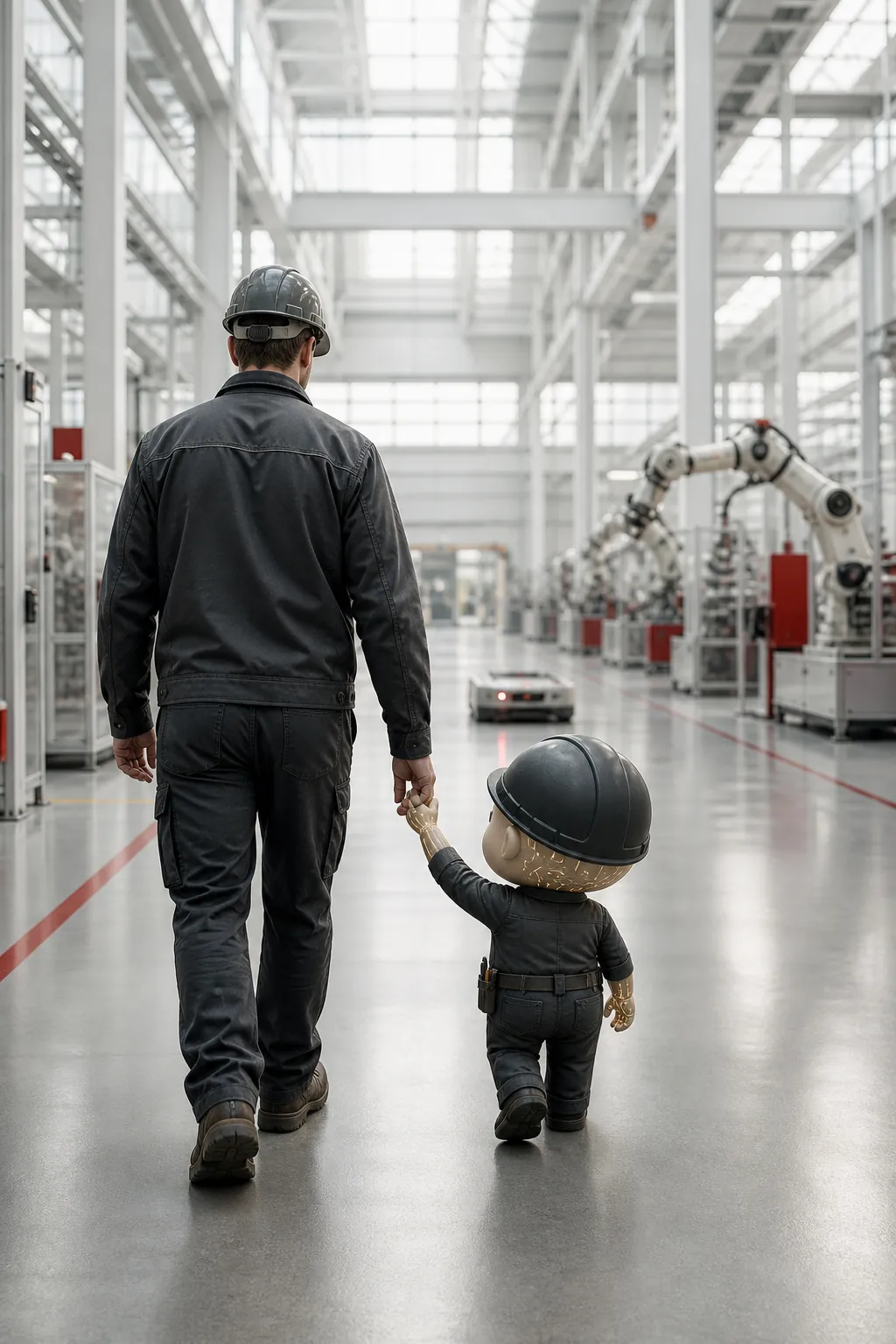
A robot executes a fixed motion with high precision and no judgment, and does not know when the situation has changed underneath it. Generative AI is a different category of machine. It can read a maintenance log, cross-reference a failure pattern, and propose a diagnosis it was never explicitly programmed to produce. The right mental model is not a faster robot, or even a smarter robot. It is closer to a new kind of coworker: a companion that combines the raw capability of an expert with the judgment of a child. It has read essentially everything relevant to the task. It has earned almost none of the trust that comes from having been right, under pressure, in this specific plant, before.

The toolbox of our companion. Understanding what an AI companion is made of matters before deploying one. An agent is the brain and the soul of the companion, the layer that reasons, holds memory of what has happened, and decides what to do next. A skill is a learned practice, a defined and reusable capability the agent can call on, closer to a trained habit than a one-off improvisation. A routine is a timed workflow, something that runs on a schedule or a trigger rather than being reasoned about fresh each time. The Model Context Protocol is what lets the agent's skills and routines reach the systems that matter (the ERP, the historian, the quality database) rather than working from a description of those systems instead of a live connection to them.
The harness is what holds the rest together and it is the part most often left out. A language model predicts the most likely next token, so asking the same question ten times returns ten variations, and a plant cannot run a qualified process on a machine that answers differently each time it is asked. The harness is the layer that removes that variance: the platform where state, codified workflows and enforcement live, so that the agent executes a path that was decided in advance and a run can be replayed rather than merely repeated. The agent is the disposable part, and the harness is what makes it safe to say so.
Reasons, holds memory of the run, decides what to do next.
A defined, reusable capability the agent can call.
Runs on a schedule or a trigger rather than being reasoned about fresh each time.
The open protocol that lets skills and routines touch the real systems rather than a description of them.
A single outlined box labelled the harness — what governs the companion, and, on its other side, constrains, enforces, records. Inside the box sit four cards. 01, Agent: the brain — reasons, holds memory of the run, decides what to do next. 02, Skill: a learned practice — a defined, reusable capability the agent can call. 03, Routine: a timed workflow — runs on a schedule or a trigger rather than being reasoned about fresh each time. 04, MCP: the toolbox — the open protocol that lets skills and routines touch the real systems rather than a description of them. Below the box, outside it, a line reads plant systems: ERP, historian, MES, quality database. The enclosure is the claim: the four parts reach the plant only through the harness, which constrains the companion to a stated intent and records what it did.
Open standards, and why "bring your own agent" is the emerging norm. The market is moving away from a single, vendor-locked AI assistant and toward agent-agnostic infrastructure, in the same way World Class Manufacturing itself established shared standards, like TPM and single-minute exchange of die, that any plant could adopt regardless of vendor. NVIDIA's Agent Toolkit, built around an open runtime called OpenShell and a family of open models called Nemotron, is explicitly positioned this way: bring whichever agent or model fits the task, run it on infrastructure that does not lock you to one vendor's roadmap.
For a bring-your-own-agent to understand a plant it has never seen before, it needs to have access to tools via the Model Context Protocol, the same way a new hire needs access to company-specific information when starting. Making this integration easier is the subject of industry standards (i3X, Catena-X, and the Asset Administration Shell) and their importance will increase significantly.
What it costs to hold complexity. Every discipline World Class Manufacturing brought to bear on Schonberger's mismatch was, at bottom, a technique for reducing complexity so that a person could hold it. Cellular layout, the focused factory, standard work, single-minute exchange of die, pull scheduling, levelled production: each one shrinks the number of interacting variables a human being has to keep in mind at once. That was the correct response, and it was correct because the cost of managing complexity was very high. Holding the whole tangle in one head was not possible, so the tangle had to be made smaller. That is the constraint Section 1 asked you to hold, and it is the one that has moved.
The inflection point is that this cost is now falling faster than almost any input cost in industrial history. Stanford's AI Index measured the price of querying a model at a fixed capability level dropping from twenty dollars per million tokens in late 2022 to seven cents by late 2024, a 280-fold reduction in roughly eighteen months. Epoch AI tracks a median decline near fifty times per year across benchmarks, accelerating since the start of 2024. a16z named the phenomenon LLMflation and put it at roughly a thousandfold over three years for a fixed quality bar, with hardware cost falling around thirty percent annually underneath it. Whatever the exact figure for a given task, the direction and the order of magnitude are not in dispute.
One caveat belongs here rather than in a footnote, because it disciplines what follows. The cost of a token is collapsing; the cost of a decision is not collapsing at the same rate, because the amount of reasoning demanded per task is rising as fast as the unit price falls. Enterprise spending on these systems has risen sharply over precisely the period unit costs fell a thousandfold, which is Jevons' paradox behaving exactly as it always has. The correct planning assumption is not that managing complexity becomes free. It is that it becomes cheap enough that the binding constraint moves somewhere else.

Section 3Permalink
Six Organizing Principles
Each revolution is defined by an organizing principle, so the useful question is which principles follow from this one. They can be derived rather than asserted.
Start with Jay Galbraith, writing in 1974. An organization is an information-processing system, and the greater a task's uncertainty, the more information must be processed between decision-makers while the task is performed. He gave four ways to cope. Two reduce the information that has to be processed, through slack resources and self-contained tasks. Two increase the capacity to process it, through vertical information systems and through lateral relations such as liaison roles, task forces and standing meetings.
World Class Manufacturing is almost entirely the first branch. Cellular layout, the focused factory, standard work, levelling, single-minute exchange of die: each strips information out of the point of work. That was the right branch, because the second was expensive. Capacity meant people, layers and meetings, every one of which added latency to the decision it was meant to improve. Generative AI is the first expansion of the second branch that reaches the point of work instead of sitting above it.
Six organizing principles
| Principle | Explained | What has changed | Rules out |
|---|---|---|---|
| 1. Organize around the flow, not the function | A company builds systems that look like its own org chart, so organizing by department gets you departmental systems and departmental decisions. The only thing a customer pays for is a finished part moving through the plant. Goldratt's four concepts of flow, after Ford and Ohno; Conway's Law. | One person can hold a whole flow, because the functional depth that used to require four specialists can now be summoned as needed. | A cross-functional outcome owned by a function. Departmental targets that can each be met while the flow degrades. |
| 2. Mobilize capability to the problem, not the problem to capability | Where a problem gets fixed depends on what it costs to get help to it. When help is expensive, problems queue up and wait for a specialist; when it is cheap, they get fixed on the spot. Andon and jidoka; Galbraith on lateral relations. | The cost of putting capable tools in an operator's hands has collapsed, so more is resolved at the machine, or against a virtual representation of it, before anyone is called. | Routing a problem upward to be answered by a better-resourced layer, and paying for the journey in latency. |
| 3. Tie accountability and reward to the finished good | People improve whatever you measure them on, so a stand-in for the real goal gets improved instead of the goal. And when the plan does not cover a situation, someone decides anyway, so it should be clear in advance who. Goodhart's Law, in Strathern's formulation; Holmström and Milgrom on multitask incentives; Hart on incomplete contracts. | Cost and quality at the level of the finished good arrive close enough to real time to act on, which makes the outcome a usable measure rather than a retrospective one. | A set of functional metrics standing in for the outcome. A role accountable for a result without the authority to decide it. |
| 4. Management by exception, finally executable | Most coordination does not change anybody's answer. Telling the useful kind from the rest used to mean reviewing everything, which cost more than it saved. Taylor's exception principle, Shop Management, 1903; Ju's monotonicity test. | Examining everything in order to find what is genuinely exceptional is no longer prohibitively expensive. | Status reporting defended as governance. Escalation that triggers on a calendar rather than on a condition. |
| 5. Codify what is learned, so the organization keeps it | What a plant knows lives in the routines it can repeat, not in its binders. Anything that exists only in one person's head walks out of the building when they do. Nelson and Winter on routines as organizational memory; Nonaka on tacit-to-explicit conversion. | Turning judgment into an executable routine no longer requires a programmer, so the person who holds the knowledge can be the one who writes it down. | Knowledge that leaves when a person does. Improvement events that never compound. |
| 6. Build the capability to change the capabilities | Written-down routines work until the situation changes, and then they hold you to the past. Keeping them current is a separate job someone has to own, because it does not happen by itself. Teece on dynamic capabilities: sensing, seizing, transforming; Winter on the distinction from ordinary capabilities. | Reconfiguring a routine is cheap enough to do continuously rather than at intervals, which moves the constraint from the cost of changing to whether anyone is watching for the need. | A standard nobody is empowered to change. Codification treated as a project with an end date. |
Every recommendation in this blueprint traces back to one of these.

What would falsify this
Each claim below is stated with what would show it to be wrong. Where an observable resolves, the entry is marked resolved rather than quietly rewritten.
Why Industry 4.0 Did Not Deliver
Detection without workflow. If systems that stop at an alert deliver returns comparable to loops that close on a written record, an updated standard or a decision put in front of a named person, the central diagnosis of this paper is wrong and the Industry 4.0 return went somewhere else.
ObservableRealised savings from detection-only deployments, in the P&L rather than in avoided-cost models.
Skipping the fourth revolution. If completing a platform-first programme turns out to be a precondition for a workflow-first one rather than an alternative to it, the historical analogy fails and the recommendation reverses. There was no prize for perfecting a line-shaft factory before installing unit drive, but that only holds if the instrumentation layer does not have to be finished first.
ObservableWorkflow-first builds failing at a materially higher rate in partially instrumented plants than in fully instrumented ones, for reasons of data reachability rather than organizational readiness.
Integration cost as the binding constraint. (cross-cutting) If deployments consistently fail on data reachability rather than on workflow design, the ordering argued here is wrong, and the correct first move is data access.
ObservableEngagement-level cost breakdowns showing integration work dominating in cases where the workflow design was sound.
What Has Changed Now
The price of holding complexity. If the price of a fixed capability level stops falling, the argument that complexity management becomes cheap enough to move the binding constraint elsewhere fails, and reducing complexity at the point of work remains the only affordable answer.
ObservableTwo consecutive years without a material fall in cost per unit of fixed capability. Rising total spend is not the falsifier, since this paper predicts it.
Agent-agnostic infrastructure. If the practical answer settles on single-vendor stacks with proprietary connective layers, the bring-your-own-agent argument was a preference rather than a direction.
ObservableProduction deployments concentrating in integrated vendor stacks through 2028, with the open protocol ecosystem thinning rather than broadening.
Open standards adoption. If i3X adoption stalls, the purchasing discipline argued here loses its object.
ObservableA negligible number of production, non-pilot deployments by 2028, or the withdrawal of significant backers from the CESMII consortium. The same test applies to Catena-X and the Asset Administration Shell.
Six Organizing Principles
Which branch is cheaper. If capability at the point of work stays more expensive than reducing the information the point of work has to handle, the second branch never becomes the affordable one and the classical answer holds. The whole set of six principles is derived from the claim that the cheaper branch has switched.
ObservableTwo consecutive years without a material fall in cost per unit of fixed capability.
The coordination tax. If coordination is either much smaller than claimed or not addressable in practice, principle four has no basis.
ObservableMeeting-hours, decision latency, escalation tier and information-lag rework failing to move where a flow has demonstrably been rebuilt.
Codification against drift. If routines that are published and run unattended drift faster than they save, principle five has moved the problem rather than solved it. A routine running at scale is more dangerous than a specialist who answers slowly.
ObservableAn audit of published routines at twelve months against what the process actually does, with a majority having drifted unnoticed.
Four outcomes that look like refutation
A pilot that fails. Builds fail for ordinary reasons: the wrong flow, the wrong person, a vendor who oversold, a data source that turned out to be unreadable. None of that speaks to the argument.
A plant that cannot staff the role. That is a constraint on adoption rather than a fault in the design.
Total spend rising. Unit costs falling while total spend rises is Jevons’ paradox behaving normally.
Adoption slower than the dates suggest. Most of the dates here are attached to other people’s roadmaps, and roadmaps slip. A specification that lands eighteen months late is not a specification that does not land.
Sources
The title of this series was inspired by Richard J. Schonberger’s World Class Manufacturing: The Lessons of Simplicity Applied, published by the Free Press in 1986. That book gave manufacturers a shared vocabulary for simplicity, flow and the elimination of waste, and its influence remains legible four decades later in how plants are laid out, measured and improved. The argument made here revises that work in an attempt to reflect evolutions in digital technology development.
Bibliography
Schonberger, Richard J. World Class Manufacturing: The Lessons of Simplicity Applied. New York: Free Press, 1986. Source of the three geometries diagram and of the complexity-reduction argument this paper revises.
Perez, Carlota. Technological Revolutions and Financial Capital: The Dynamics of Bubbles and Golden Ages. Cheltenham: Edward Elgar, 2002. https://www.e-elgar.com/shop/gbp/technological-revolutions-and-financial-capital-9781843763314.html The techno-economic paradigm concept.
Perez, Carlota. “Technological revolutions and techno-economic paradigms.” Cambridge Journal of Economics 34, no. 1 (2010): 185–202. https://doi.org/10.1093/cje/bep051
David, Paul A. “The Dynamo and the Computer: An Historical Perspective on the Modern Productivity Paradox.” American Economic Review 80, no. 2 (1990): 355–361. The delay argument, and the phrase about overlaying one technical system upon a preexisting stratum. https://www.jstor.org/stable/2006600
Devine, Warren D., Jr. “From Shafts to Wires: Historical Perspective on Electrification.” Journal of Economic History 43, no. 2 (1983): 347–372. Line shafting economics, the floor space penalty, and the transition to unit drive.
Stanford Institute for Human-Centered AI. AI Index Report 2025. The fall from twenty dollars to seven cents per million tokens at a fixed capability level, a 280-fold reduction in roughly eighteen months. https://hai.stanford.edu/ai-index/2025-ai-index-report
Epoch AI. “LLM inference prices have fallen rapidly but unequally across tasks.” Median decline near fifty times a year across benchmarks. https://epoch.ai/data-insights/llm-inference-price-trends
Appenzeller, Guido. “Welcome to LLMflation: LLM inference cost is going down fast.” Andreessen Horowitz, November 2024. https://a16z.com/llmflation-llm-inference-cost/ Roughly a thousandfold over three years for a fixed quality bar.
Bresnahan, Timothy F., and Manuel Trajtenberg. “General purpose technologies: ‘Engines of growth’?” Journal of Econometrics 65, no. 1 (1995): 83–108. The three properties of a general-purpose technology. https://doi.org/10.1016/0304-4076(94)01598-T
Anthropic. “Introducing the Model Context Protocol.” November 2024. https://www.anthropic.com/news/model-context-protocol
Google. “Announcing the Agent2Agent Protocol (A2A).” April 2025. https://developers.googleblog.com/en/a2a-a-new-era-of-agent-interoperability/
CESMII. Industrial Information Interoperability eXchange (i3X). Version 1.0 released 18 June 2026 following an April 2026 beta, backed by more than forty technology providers. https://www.cesmii.org/cesmii-releases-i3x-1-0/
Catena-X Automotive Network. https://catena-x.net/
Industrial Digital Twin Association. Asset Administration Shell specifications. https://industrialdigitaltwin.org/
Galbraith, Jay R. “Organization Design: An Information Processing View.” Interfaces 4, no. 3 (1974): 28–36. The four coping strategies these principles are derived from. https://doi.org/10.1287/inte.4.3.28
Ju, Harang. “When coordination is avoidable: A monotonicity analysis of organizational tasks.” Proceedings of the National Academy of Sciences 123, no. 31 (4 August 2026). The primary source for the coordination-tax figures. Worth reading directly rather than through summaries, because the workflow-level and task-level figures are routinely conflated and the conservative task-level figure is the one to plan against. https://doi.org/10.1073/pnas.2606267123
Taylor, Frederick W. Shop Management. New York: Harper & Brothers, 1911. First presented to the American Society of Mechanical Engineers in 1903. The exception principle.
Goldratt, Eliyahu M., and Jeff Cox. The Goal: A Process of Ongoing Improvement. Great Barrington, MA: North River Press, 1984. The flow concepts behind principle one.
Conway, Melvin E. “How Do Committees Invent?” Datamation 14, no. 4 (April 1968): 28–31. http://www.melconway.com/Home/Committees_Paper.html
Holmström, Bengt, and Paul Milgrom. “Multitask Principal-Agent Analyses: Incentive Contracts, Asset Ownership, and Job Design.” Journal of Law, Economics and Organization 7, special issue (1991): 24–52. https://doi.org/10.1093/jleo/7.special_issue.24 Unmeasured effort decays, behind principle three.
Strathern, Marilyn. “‘Improving ratings’: audit in the British University system.” European Review 5, no. 3 (1997): 305–321. The formulation of Goodhart’s Law used here.
Nelson, Richard R., and Sidney G. Winter. An Evolutionary Theory of Economic Change. Cambridge, MA: Belknap Press, 1982. Routines as organizational memory. Behind principle five.
Nonaka, Ikujiro, and Hirotaka Takeuchi. The Knowledge-Creating Company: How Japanese Companies Create the Dynamics of Innovation. New York: Oxford University Press, 1995. Tacit to explicit conversion.
Teece, David J., Gary Pisano and Amy Shuen. “Dynamic Capabilities and Strategic Management.” Strategic Management Journal 18, no. 7 (1997): 509–533. Sensing, seizing and transforming, behind principle six.
Winter, Sidney G. “Understanding Dynamic Capabilities.” Strategic Management Journal 24, no. 10 (2003): 991–995. https://doi.org/10.1002/smj.318
The blueprint author

Hendrik Lojek
ForgeShift Advisory
My firm ForgeShift advises manufacturers on operations improvement and technology adoption
Based on the principles set out in ‘World Class Manufacturing in the Age of AI’.
Pygmalion Capital
Through my investment vehicle Pygmalion Capital I acquire manufacturing businesses
To make them lighthouses for World Class Manufacturing in the Age of AI.
Background
Previously Senior Director at Magna International, and before that a strategy consultant at Strategy&
Held group responsibility for manufacturing process technology and Industry 4.0 across a network of 60+ plants
Built and led a cross-functional process expert and software development team of 20+ amazing individuals with an annual budget over USD 10M
Working on digital business development in manufacturing since 2017 · M.Sc. Industrial Engineering, TU Braunschweig
worldclassmanufacturing.aiWorld Class
Manufacturing
in the Age of AI
Skip the Fourth Industrial Revolution